

Why Your Content Isn’t Bringing You Clients (And What’s Missing)
Most Firms Are Already Creating Content
Most professional firms are already putting real effort into content. They post on LinkedIn. They create educational posts, articles, videos, and industry commentary to stay visible and build credibility. From the inside, it feels like momentum should be building. But after a while, many businesses run into the same frustration. The content keeps going out, yet very little changes. Engagement stays inconsistent. Enquiries do not improve in a meaningful way. Over time, it becomes difficult to tell whether content is actually contributing to growth at all. That is usually the point where businesses start questioning whether content marketing works.
In many cases, the issue is not effort. It is that the content was never built around a clear visibility strategy in the first place.
Posting Content Is Not the Same as Building Visibility
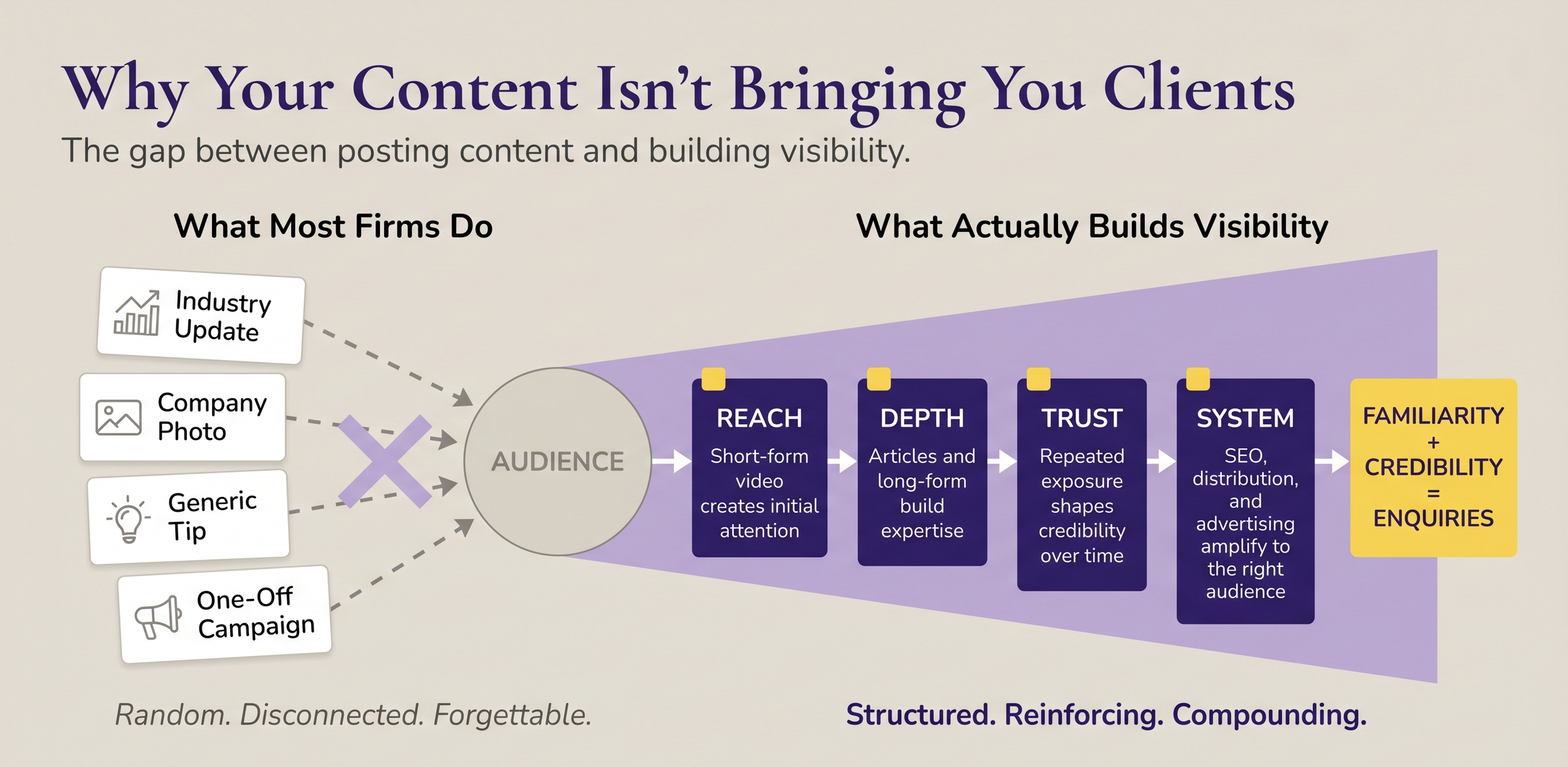
One of the biggest misconceptions in content marketing is the idea that consistency alone creates results. It does not. Posting regularly can create activity, but activity does not automatically create attention, trust, or demand. Most firms are not struggling because they never post. They are struggling because the content often feels random, disconnected, or created without a clear understanding of what potential clients actually care about. A business might post an industry update one week, a company photo the next, and a generic educational tip after that. From the inside, it feels productive. From the audience’s perspective, there is rarely a clear reason to keep paying attention.
That is the difference between posting content and building visibility.
Content Is Everywhere Now
Content is no longer uncommon.
Every industry is producing it. Lawyers, accountants, consultants, agencies, advisors, medical firms, property businesses. Everyone understands that visibility matters, which means audiences are constantly exposed to information competing for their attention. The volume of content has increased dramatically. Attention has not. This is why simply “showing up” rarely works anymore. Professional and educational content is naturally harder to make engaging because people do not consume it the same way they consume entertainment. Audiences decide very quickly whether something feels relevant, useful, or worth their attention.
That decision is influenced by far more than expertise alone. Structure matters. Clarity matters. Relevance matters. Presentation matters. The way information is explained matters. Most professionals are experts in their field, not in audience attention. And those are two very different skill sets.
Why Quality Matters More Than Frequency
A lot of firms treat content creation as a discipline problem. Post consistently. Stay active. Keep publishing. But quality matters just as much as frequency. Without quality, consistency simply creates more noise. Potential clients are not looking for endless information. They are looking for signals. Signals that you understand their problems. Signals that your thinking is relevant. Signals that your expertise can be trusted.
This is where many businesses struggle.
They create content based on what they want to say rather than what their audience actually wants to engage with. The result is often content that is technically accurate but commercially ineffective. It informs, but it does not hold attention. More importantly, it does not shape perception. For many professional firms, content becomes the first experience people have with the business. Before a conversation ever happens, potential clients are already forming impressions based on what they repeatedly see online. People may never meet you before forming an opinion about your credibility.
They meet your content first.
That is why quality matters more than volume alone. Strong content does not simply fill channels or maintain activity. It builds familiarity, authority, and trust over time. Because increasingly, your visibility shapes your reputation long before your work does.
What a Real Content Strategy Looks Like
A stronger content strategy starts with understanding the audience before creating the content itself.
What problems are potential clients already thinking about?
What questions do they repeatedly ask?
What formats are easiest for them to consume?
What actually keeps their attention long enough to build familiarity?
Once those things become clearer, content stops feeling random. Posting becomes more intentional. Topics begin reinforcing one another. Different formats support different stages of attention. Short-form videos create reach. Articles build depth. Educational content builds trust. Distribution helps the right people encounter the content consistently over time. This is where content starts becoming a system instead of a task. Not every piece needs to generate an enquiry immediately. The goal is to create repeated exposure that gradually builds familiarity and credibility over time.
Visibility Works Through Accumulation
Most clients do not reach out because of a single post. They encounter a business multiple times before making a decision. A short video introduces an idea. An article reinforces expertise. A referral creates curiosity. Another piece of content later makes the business feel more familiar and credible. These interactions accumulate. That is what makes visibility work. Not one post or campaign or one moment of attention. But a consistent system where expertise is presented clearly, professionally, and repeatedly to the right audience over time.
The strongest visibility strategies combine content, distribution, SEO, and performance marketing. Because visibility alone is not enough. Posting random content is not visibility. Real visibility happens when the right audience repeatedly encounters clear expertise across multiple touchpoints. SEO helps businesses appear when people are already searching for solutions. Performance marketing places expertise in front of targeted audiences earlier in the decision-making process. Content builds familiarity, recognition, and trust over time. Strong visibility comes from these channels working together, not separately.
Why Strategy Matters More Than Volume
The firms building strong visibility today are not necessarily producing the most content. They are usually producing clearer content. Content that understands the audience. Content that holds attention. Content that reinforces expertise consistently. Content supported by structure, distribution, SEO, and strategy. Because the challenge is not simply creating more content. It is creating content that people actually remember. And more importantly, content that continues working long after it is published. The firms winning attention today are not always the loudest. They are usually the clearest, most consistent, and easiest to remember.
Key Takeaways
Posting regularly does not automatically create visibility, trust, or enquiries.
Professional expertise and content strategy are different skill sets.
Quality, audience understanding, and structure matter just as much as consistency.
Strong content works as a system where different touchpoints reinforce one another over time.
SEO, distribution, and performance marketing help amplify visibility to the right audience.
If This Sounds Familiar
If your business is posting content regularly but still struggling to generate consistent enquiries, the issue may not be effort. It may simply be that the content was never built around a clear audience and visibility strategy. We have broken this down into a practical marketing playbook covering content strategy, audience attention, visibility systems, SEO, and distribution frameworks designed specifically for professional firms.
Download the Marketing Playbook here.