
How to Get Consistent Clients Without Guessing What Will Work Next
For most professionals, growth begins with the work itself. Some firms gain traction early. Clients return, referrals come in, and momentum builds naturally. Others struggle to get noticed despite doing strong work. But over time, both often run into the same problem: growth feels unpredictable.
There are periods when enquiries arrive steadily and the business feels full. Then things quiet down just as quickly, without a clear reason why. The work itself may not have changed, yet demand moves in waves.
That uncertainty creates pressure. Not necessarily because the business is failing, but because there is no reliable way to understand where the next client will come from or when momentum will return.
The Limits of Passive Demand
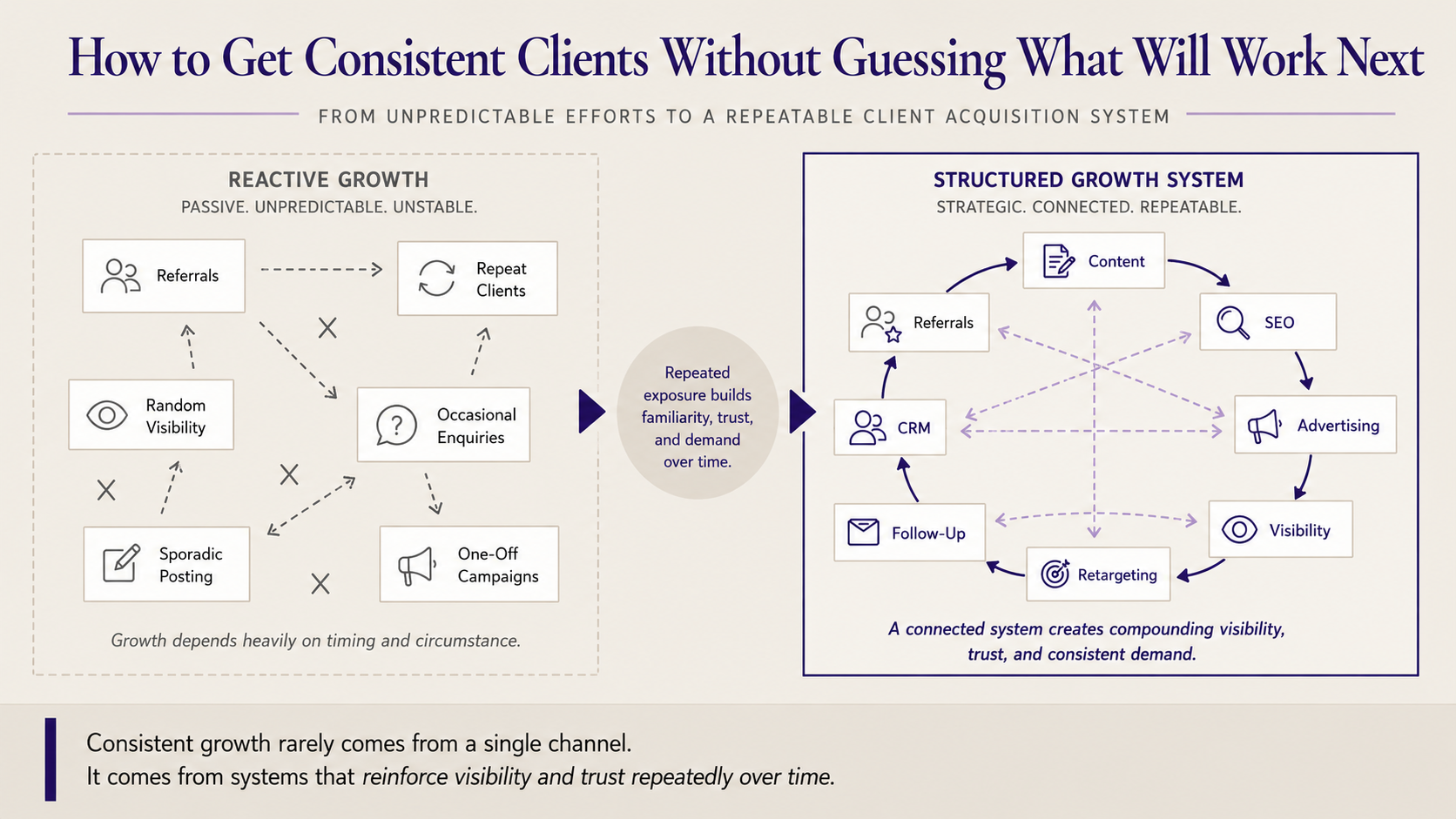
For many firms, growth still depends heavily on existing relationships. Referrals, repeat clients, and occasional organic visibility carry most of the business. Beyond that, demand is largely passive. Firms are not actively reaching new audiences so much as waiting to be discovered.
This works for a while, particularly when reputation is strong. But it also creates a dependency on timing and circumstance. Work comes in when a former client returns, when someone passes your name along, or when the right person happens to find you at the right moment.
When those things slow down, the gap becomes difficult to ignore.
There is no clear system supporting demand. No reliable way to create visibility beyond the existing network. Only the hope that momentum eventually picks up again.
Reality of Reactive Marketing
At that point, activity often becomes reactive. A few posts go out. A campaign is tested. Different channels get explored for a period of time. But without a larger structure behind them, these efforts rarely build on one another.
So when demand returns, the urgency fades and the cycle repeats.
The issue is usually not effort. Most firms are already working hard. The problem is that growth has never been built around a repeatable system.
The Shift from Prediction to Control
That is where marketing becomes important.
Not simply as promotion, but as a way to make demand more visible, measurable, and controllable over time.
Used properly, marketing changes the nature of the business. Instead of relying on when opportunities happen to appear, it allows firms to reach the right audience deliberately. Visibility expands beyond referrals and existing relationships, creating a more stable foundation for growth.
Rethinking the Role of Advertising
Advertising plays an important role here, though not always in the way people expect.
Many businesses approach ads as a direct conversion tool and judge them purely by immediate enquiries. But their value often starts earlier in the decision process. Ads create exposure among the right audience, ensuring your business is seen consistently rather than occasionally discovered by chance.
That visibility matters because clients rarely make decisions from a single interaction. They search, compare, revisit, and form impressions over time. A piece of content may introduce an idea. A website may reinforce credibility. A conversation or referral may bring someone back later when the need becomes more urgent.
None of these moments work particularly well in isolation.
Together, they shape how decisions are made.
Why Disconnected Efforts Underperform
This is why disconnected marketing efforts tend to underperform. Content without distribution struggles to reach the right audience. Advertising without clear messaging creates attention without trust. Referrals without visibility leave too much to assumption.
Each activity may produce occasional results, but nothing compounds.
Over time, this also distorts how businesses judge the cost of marketing. An ad is expected to convert immediately. A piece of content is expected to generate enquiries on its own. When that does not happen, the investment feels difficult to justify.
The Non-Linear Client Journey
Client acquisition rarely happens in a straight line.
Most clients encounter a business multiple times before reaching out. They may see an ad, revisit the website later, read an article, compare alternatives, and return weeks afterward once the timing feels right.
Viewed separately, these interactions can appear ineffective.
Viewed together, they form a system that supports how decisions actually happen.
That is what creates consistency.
Not more activity for the sake of activity, but a structure where visibility, trust, and follow up reinforce one another over time.
Building a Consistent System
The firms that grow steadily are rarely relying on a single channel or waiting for referrals alone. They build systems that allow demand to be generated more deliberately, measured more clearly, and improved over time.
That shift changes growth from something unpredictable into something far more controllable.
Key Takeaways
Inconsistent client flow is often the result of passive demand rather than poor work.
Referrals and repeat clients can sustain growth for a period of time, but they are difficult to scale or predict on their own.
More consistent enquiries come from building a system where visibility, content, advertising, and follow-up work together over time.
If This Sounds Familiar
If growth feels unpredictable despite doing strong work, the issue may not be the quality of the business itself. It may simply be that demand has never been supported by a structured system.
We have broken this down into a practical marketing playbook that explains how visibility, content, advertising, and follow up can work together to create more consistent enquiries over time.